By Nikki Johnson
In previous articles, we explored the issue of net domestic out-migration and its impact on population growth in the Hampton Roads region. Over the past decade, Hampton Roads has consistently lost more residents to other parts of the country than it has gained. As birth rates decline and deaths increase due to an aging population, domestic migration has become a significant driver of population growth trends across metro areas.
Migration rates are highest among young adults. To shed light on their migration patterns, a study released in 2022 by the U.S. Census Bureau and Harvard University used census surveys and tax data for individuals born between 1984 and 1992. The study tracked the movement of individuals from their hometown commuting zone, a combination of cities and counties that reflect a local labor market where most residents live and work, at age 16 to where they wound up at age 26. The data showed that the majority of young adults in the U.S. don’t venture far from home. By age 26, 69% of young adults still lived in the same commuting zone they grew up in. Nearly eight in ten had moved less than 100 miles away, and nine in ten had moved less than 500 miles away. These migration patterns varied across race and ethnicity, and parental income, with people of color and individuals from low-income households tending to move the shortest distances.
The Hampton Roads metro area is divided across two commuting zones: the Virginia Beach CZ includes the cities in southeast Hampton Roads and some counties from NE North Carolina, while the Newport News CZ encompasses the rest of the metro area and parts of the Middle Peninsula. As illustrated in Figure 1, 65% of individuals who grew up in the Virginia Beach CZ remained in the area as young adults. Another 15% moved less than 200 miles away to other parts of Virginia and North Carolina, while the remaining 21% relocated to other states. A similar pattern emerges in the Newport News CZ (Figure 2), where 58% of individuals remained in the area as young adults, 18% moved to another part of Virginia, and 24% moved to other states. While these patterns indicate that a majority of young adults from the region remain in the area, the region retains fewer young adults than the national average.
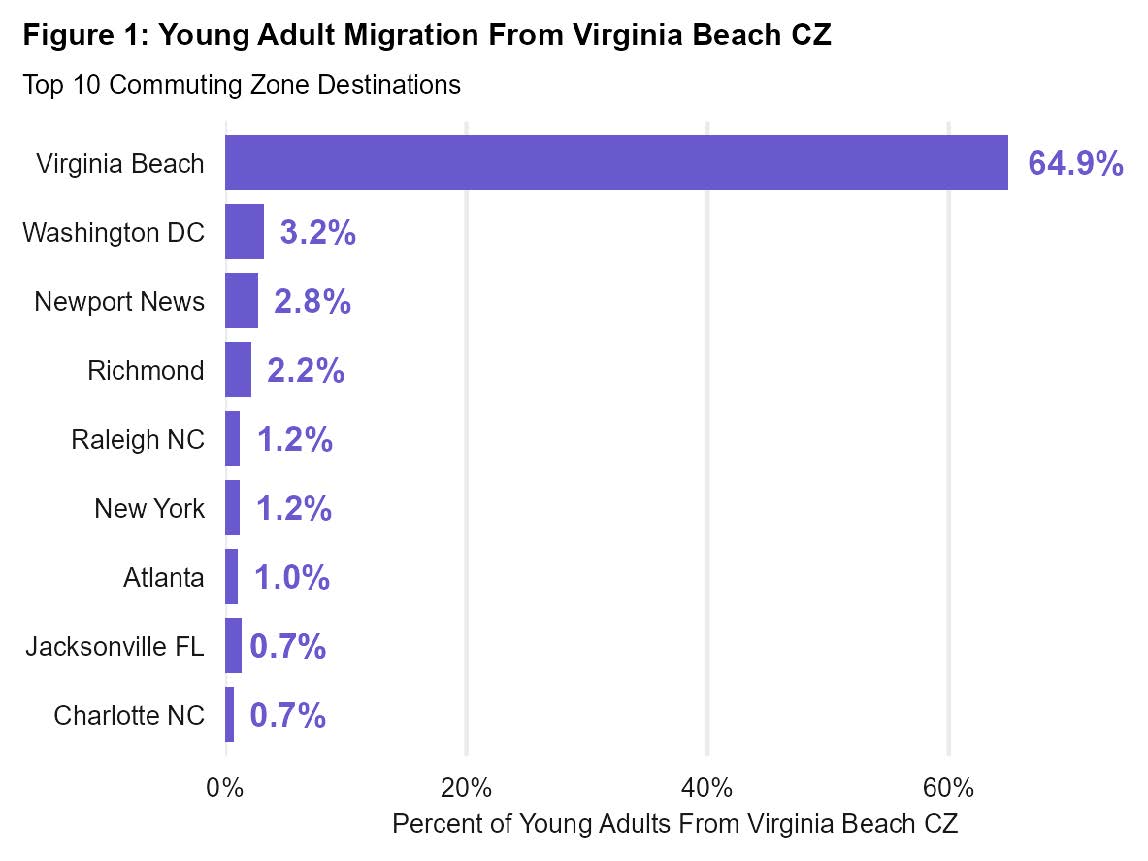
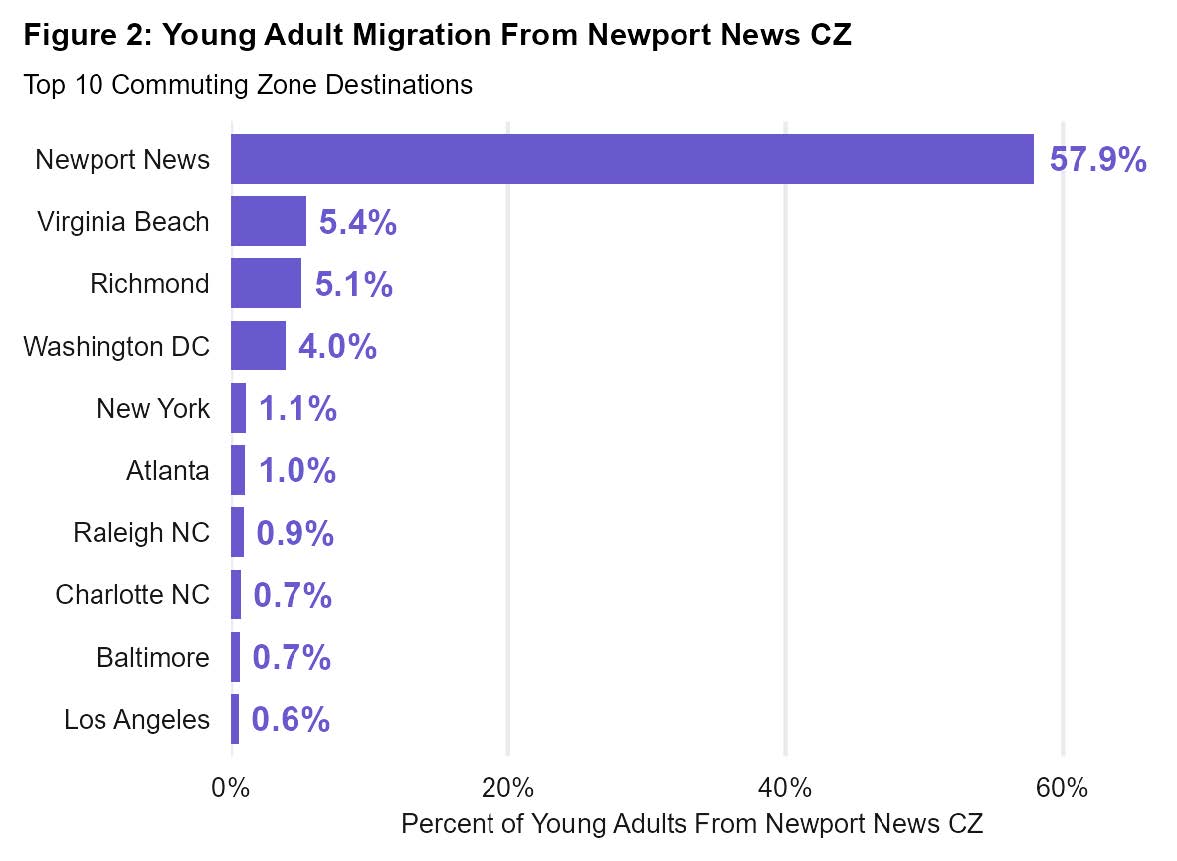
Data source: U.S. Census Bureau and Opportunity Insights Young Adult Migration (2022), HRPDC.
Nearby densely populated areas were top destinations for young adults leaving the region, typically offering greater job opportunities and amenities that attract young talent. The opportunity for higher wages also influences migration patterns. A central finding of the study estimated that in areas with an elastic housing supply, improvements in labor market conditions were associated with positive and geographically concentrated benefits.
The data presented here shows that many of the regions we compete with to retain young adults are not far from home. Creating an environment of job opportunities, amenities, and competitive wages that attract and retain young talent is vital for the resilience of the regional economy.
Read the rest below or by downloading the PDF.